The short answer
Yes. Audiobooks count as reading, and the science backs it up.
If you came here looking for permission, you have it. But permission from a blog post is not very satisfying, so let's look at what the research actually says, because the science here is more interesting than most people realise.
What "reading" actually is
When you read a book with your eyes, your brain does two things: it decodes the symbols on the page, and it processes the meaning of what those symbols represent. The first part, decoding, is unique to reading text. The second part, comprehension, is not.
A 2019 study by Fatma Deniz and colleagues at UC Berkeley compared how people processed narrative information through reading versus listening. Using fMRI, they found that the same brain regions were activated in both cases. The semantic networks that light up when you read "the cat sat on the mat" are the same ones that fire when you hear it read aloud. Your brain does not particularly care whether the input arrived through your eyes or your ears. (Deniz et al., Journal of Neuroscience, 2019)
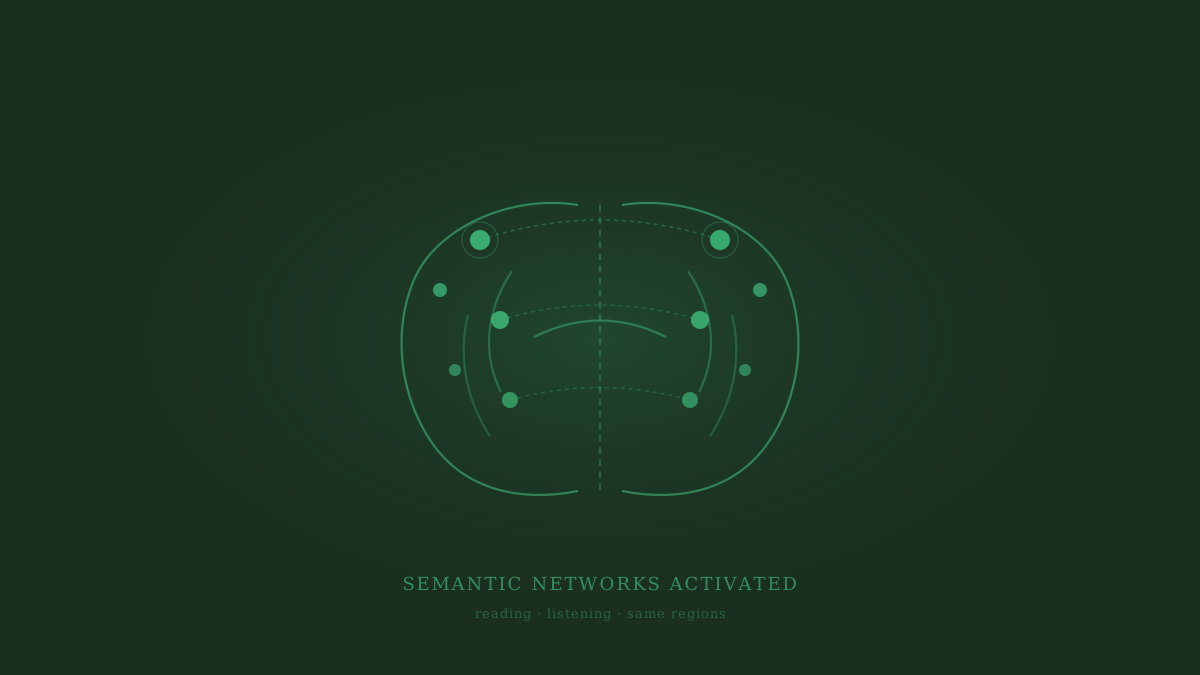
This makes sense when you think about how humans have actually processed stories for most of history. Written language is roughly 5,000 years old. Storytelling, passed down orally, is at least 100,000 years old. Our brains are extraordinarily well-adapted to understanding language we hear.
The semantic networks that light up when you read are the same ones that fire when you listen. Your brain does not care whether the input came through your eyes or your ears.
But do you retain as much?
This is where it gets more nuanced, and where the honest answer is: it depends on the person and the material.
Some studies suggest that readers retain slightly more from text than from audio for complex, technical material. One often-cited 2010 study found higher comprehension scores for text reading. But a more recent 2021 study from Frontiers in Psychology found no significant difference in comprehension or recall between reading and listening for narrative fiction.
The difference, when it shows up, is probably not about whether ears are worse than eyes. It is about attention management. When you are reading, your eyes physically slow down at difficult passages. When you are listening, the narrator keeps moving whether you are keeping up or not. That is a feature of the format, not a fundamental limitation of the medium.
The fix is practical: slow the playback speed down for dense material. Read the physical book for textbooks. Use audio for narrative nonfiction and fiction, where the flow of the narration often improves the experience anyway.
The snob problem
There is a certain type of person who will tell you that audiobooks "do not count." What they usually mean, if you press them, is one of two things:
- They want to protect their reading count on Goodreads from being contaminated by what they consider a lesser activity.
- They have a vague sense that anything easier than reading physical text is somehow cheating.
The first concern is just gatekeeping with extra steps. The second is more interesting because it reveals a weird assumption that difficulty equals value. By that logic, people who read quickly should get fewer points than slow readers. Nobody argues that.
The actual measure of whether reading is valuable is: did you absorb the ideas, were you moved by the story, did it change how you think? Format is not in that list.
When audiobooks are actually better
For some books, audio is not just equivalent, it is the superior format. Anything with a great narrator (a presidential memoir, a novel the author reads themselves) delivers something the text simply cannot. Nonfiction books that are essentially long essays often flow better at 1.5x audio speed than they do in print.
Travel, commuting, and exercise are time that text-reading cannot reach. If audiobooks are how you fit reading into your life, they are categorically better than the physical book gathering dust on your shelf.
The bottom line
The people who insist audiobooks do not count are, with respect, wrong. The research is on your side, the history of human storytelling is on your side, and your personal experience of having engaged with and remembered a book probably tells you the same thing.
So listen to books. Track them. Count them. You earned it.
Pick Up tracks both audiobooks and regular books. Sessions, progress, captured thoughts — all of it. Download it here. Get updates on new features as we build them — stay updated.