Goodreads is still the default. That does not make it the answer.
Goodreads has the unbeatable advantage of being the place everyone already has an account. Your friend from university is there. Your aunt is there. The person who gave Fourth Wing two stars and then wrote six paragraphs about plot logic is definitely there.
A giant book database and a giant pile of reviews are useful, so nobody needs to pretend Goodreads has no value. The issue is that if you are searching for a Goodreads alternative in 2026, you probably already know the problem: Goodreads is good at being Goodreads, but it is less good at feeling like a modern reading app.
The trick is not finding "Goodreads, but prettier". That usually leads to disappointment, because Goodreads is too many things at once: a catalogue, a social network, a review site, a recommendation engine, a reading log, and a place where people announce they are "finally tackling Dostoevsky" and then vanish for seven months.
The better question is: what do you actually want your reading app to help with?
The quick answer
1. Pick Up is best if you want a reading companion that works offline, tracks sessions, builds healthier reading habits, captures your thoughts, handles audiobooks and physical books, and keeps your reading life in one place.
2. StoryGraph is best if you want the strongest Goodreads alternative for stats and recommendations.
3. Bookmory is best if you want a simple, tidy mobile reading log.
4. Fable is best if you want book clubs and social reading.
Putting Pick Up first is not just a polite mention because this is the Pick Up blog. Goodreads mostly asks what you read and what you rated it; Pick Up is more interested in how you are actually reading, which turns out to be a very different product question.
1. Pick Up: best if you want a reading companion, not another book database
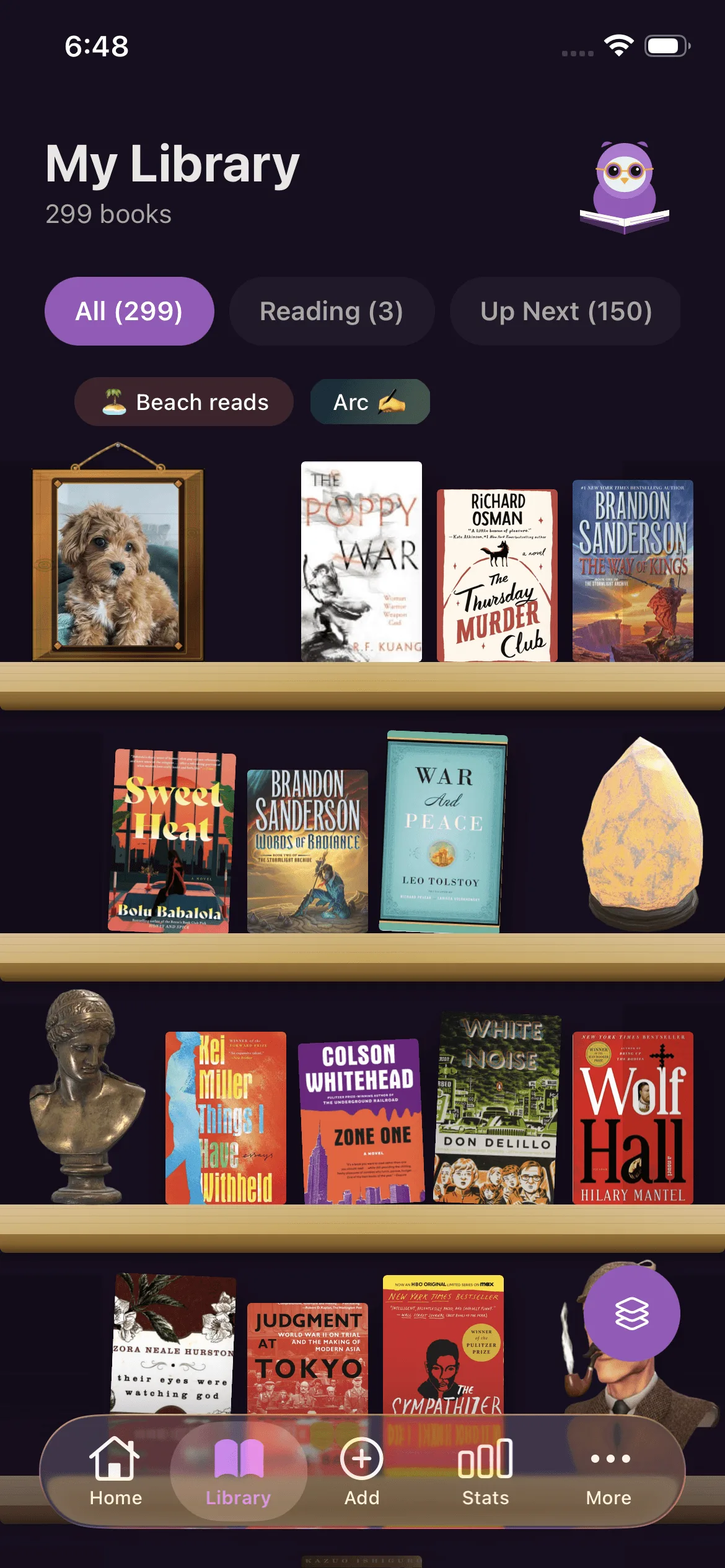
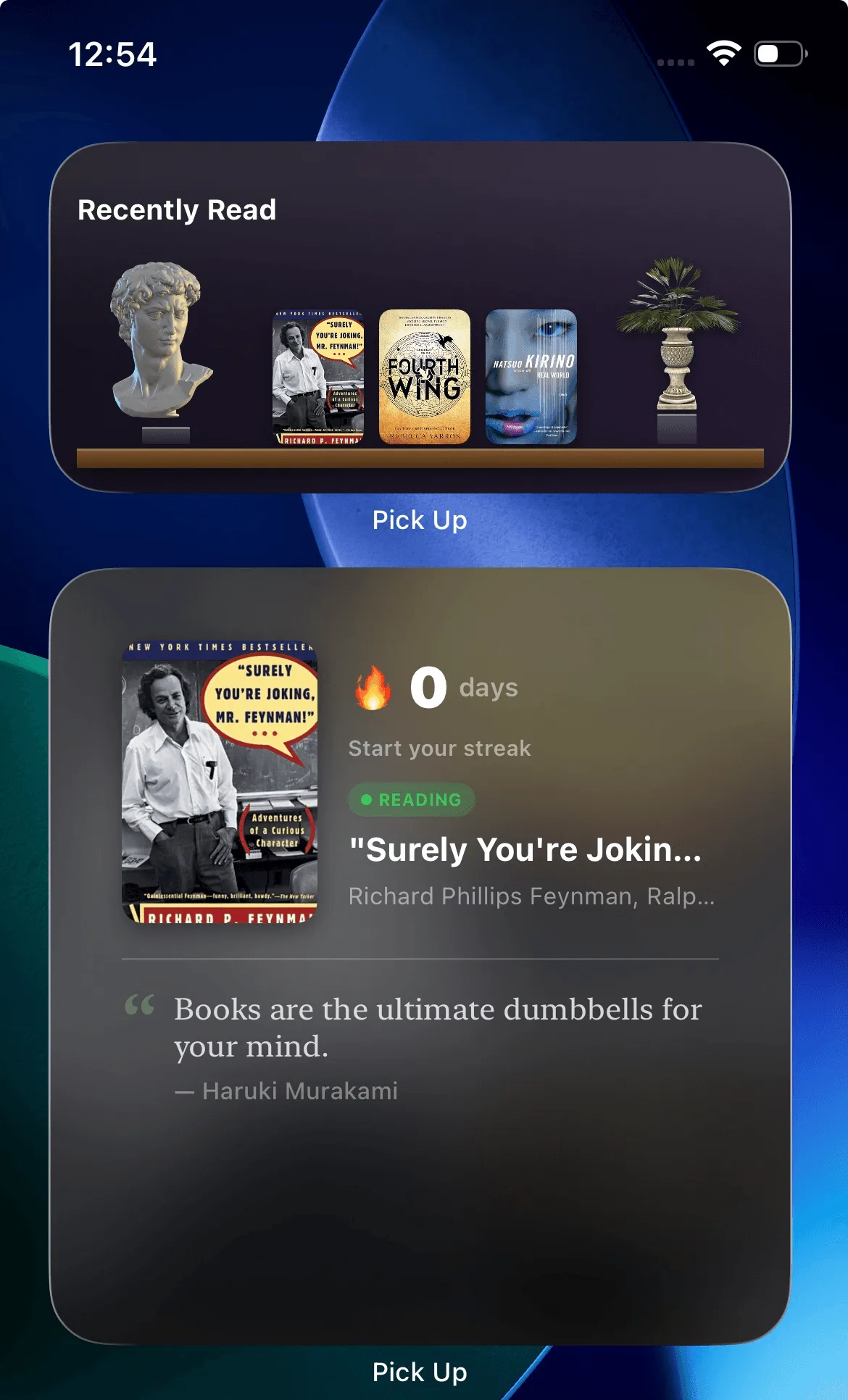
Pick Up is not trying to be Goodreads with a nicer coat, and it is also underselling it to call it a "private reading tracker", even though privacy is a big part of the point. Pick Up is more like a reading companion: the thing that sits beside your actual reading and helps you keep going, remember more, choose better, and make the habit feel good enough that you come back tomorrow.
The difference shows up immediately. Pick Up works offline and stores your reading life on your device first. No account is required to start using it. You can add books, track sessions, capture thoughts, log progress, and keep your library going without waiting for a web app to load or a social network to notice you exist.
If you do want backup and cross-device access, Premium adds cloud sync. That is the right order: local-first for trust, sync when you want it.
That matters because reading often happens in very unglamorous places. On a train with bad signal. In bed with aeroplane mode on because you are pretending to be a healthier person. In a library basement. In the passenger seat. During a lunch break where the Wi-Fi has chosen violence. A reading app should not fall apart just because the internet is not feeling emotionally available.
Pick Up is built around the session
Most book apps understand books; Pick Up spends more time understanding the reading around them. That sounds like marketing until you look at the workflow. You can start a reading session when you sit down, pause for breaks, switch into Focus Mode, use a countdown timer, and wrap up by saving your page, percentage, or audiobook progress. If you forget to start the timer, you can log a manual session afterwards so your streak and stats do not get punished because life happened.
The app treats regular books and audiobooks differently where it should. Pages are not seconds. Listening is not visually the same as reading print. Pick Up tracks audiobook progress by time, regular books by page or percentage, and uses the right language for reading and listening sessions.
After a few sessions, Pick Up can estimate your reading pace and show how long a book is likely to take. That is more useful than a vague yearly goal, because it is based on how you read, not how your most optimistic January self imagined you read.
That is where the habit piece starts to matter. Pick Up is not only counting finished books at the end; it is helping you protect the small sessions that actually finish them.
It helps you build a healthier reading habit
There is a version of reading tracking that makes people weird, where everything becomes a number and every book starts to feel like a trophy. By December, the whole hobby has quietly turned into a frantic novella sprint with quarterly targets.
Pick Up has goals, streaks, stats, calendars, personal bests, monthly recaps, and advanced insights, but they work best when they give you momentum without making reading feel like another thing you are failing to optimise.
You can set weekly, monthly, or yearly goals by books or pages. You can see days left, pace, past goals, streaks, and your reading calendar. You can set reminders so reading does not slip through the cracks. You can see your month as a recap, your year as shareable stats, and your patterns through insights like peak reading hours, pace changes, audio versus print, and reflection depth.
Good tracking helps you notice what is already working. Maybe Sunday morning is secretly your best reading time. Maybe audiobooks are carrying your month. Maybe you keep starting big books and need a shorter one between them. Maybe your reading did not disappear, it just moved to fifteen-minute pockets and you were not giving those pockets credit. A simple book log will not always show you that, but a good reading companion should.
The best feature is remembering what you thought
The most underrated reading problem is not always "what should I read next?" A lot of the time it is the quieter, more annoying problem of barely remembering the books you already read.
Pick Up is built for that moment halfway through a chapter when a thought appears and you know, with tragic certainty, that it will be gone by dinner. You can capture a thought during a session as voice or text. Voice reflections can be transcribed, so the messy thing you said while the book was still alive in your head becomes searchable later.
That matters for reviewers, ARC readers, book club people, students, and anyone who has ever finished a brilliant novel and then, two weeks later, described it as "kind of about grief, I think".
You can star favourite reflections, revisit all thoughts for a book, turn reflections into shareable cards or audiogram videos, and use Reading Journal to shape those notes into publishable entries. This is where Pick Up stops feeling like a tracker and starts feeling like an actual memory system for your reading life.
Goodreads remembers your rating. Pick Up remembers the little moments that made the rating make sense.
It covers the messy reality of how people read
People do not read in one clean format anymore. You might have a paperback on the bedside table, an audiobook in the kitchen, a Kobo on the train, a library book with a terrifying due date, and three books in your "up next" pile that are silently judging you.
Pick Up is built for that mess. You can track physical books, ebooks, and audiobooks. You can scan an ISBN barcode, search by title, or enter details manually. You can import your library from Goodreads, StoryGraph, or Bookmory so switching does not mean rebuilding your reading history by hand.
You can organise books into collections, save books for later with notes, rate finished books privately, track progress by percentage for e-readers, and use bulk library tools when your shelves need a proper tidy.
There is also a vocabulary builder, which is one of those features that sounds small until you realise how naturally it belongs inside the reading flow. During a session, you can look up a word, save the definition, attach it to the book, add your own note, and revisit your vocabulary later.
It helps you choose what to read next
Goodreads has recommendations because it has a giant social database. Pick Up approaches the problem from your own library and taste.
Book Roulette can pick from your Up Next shelf when you are stuck. The Shelf can give personalised picks based on what you own, what you like, what mood you are in, how long you want the book to be, and what format you want. There are Saved for Later lists for books you do not want in your main library yet. There are private ratings that can feed better recommendations and insights over time.
It is a more intimate version of discovery: less "the internet loved this", more "given your actual shelves and habits, this is probably the one". Sometimes that is what you need most, not more books, but a decision.
It has personality without turning reading into performance
A reading app can have every feature and still feel like homework, which is why the feel of the thing matters more than people admit. Pick Up has the practical pieces, but it also has texture: a 3D bookshelf view, wood styles, themes, Shelf Curios, cover calendars, widgets, quote cards, Monthly Recaps, and Lit Wit, a daily book trivia game where you guess whether a title is real or made up.
None of that is essential in the narrow spreadsheet sense, but reading is not a spreadsheet hobby. It is emotional and ritualistic and a bit ridiculous, and the app should understand that.
The important thing is that Pick Up's personality does not require public performance. You can share if you want. You can publish journal entries if you want. You can make audiograms and stats cards if you want. But the default centre is still your own reading, not a feed you have to maintain.
That is the line Pick Up walks well, at least when it is at its best: delightful without being needy.
2. StoryGraph: best for stats people
StoryGraph is the app most people mean when they say they want a Goodreads alternative.
It tracks what you read, what you want to read, your ratings, your reading goals, and all the usual shelf machinery. The reason people like it is the extra layer: moods, pace, length, format, challenges, DNF tracking, buddy reads, graphs that make your reading year look like it belongs in a tiny annual report.
If Goodreads is about what everyone thought of a book, StoryGraph is more interested in what your reading life looks like. Do you read mostly dark, slow literary fiction? Are your five-star books secretly all medium-paced mysteries? Did you spend February saying you were "in a slump" while somehow finishing 1,200 pages of romantasy? StoryGraph is built for that kind of self-interrogation.
It also got a very timely boost in May 2026. Kobo announced that StoryGraph sync is coming to Kobo in June 2026, making Kobo the first e-reader with native StoryGraph progress syncing. Kobo says current reads, progress percentages, and finished status will sync for Kobo account-based content, including ebooks and audiobooks.
It is a real shift, because Kindle has long had the Goodreads advantage simply by living inside Amazon's universe. Kobo adding StoryGraph gives non-Amazon readers a cleaner path into serious reading stats without having to treat Amazon as the centre of their reading life.
There is a caveat, because Kobo's own help page says highlights, notes, and back-syncing are not supported. So if your dream is "every thought I had on my Kobo magically appears in my journal", no, not yet.
StoryGraph is best if you want data, charts, recommendations, challenges, and a place that feels designed around reading patterns rather than popularity contests.
It is less ideal if you mainly want the app you open while you are reading. StoryGraph is excellent at the book-level record. Pick Up is stronger at the session-level life around the book.
3. Bookmory: best for a tidy mobile reading log
Bookmory is the app for people who want their reading tracker to feel like an actual app, not a website squeezed into a phone screen and told to behave.
It is strong on the daily mechanics: add a book, start a timer, log pages, set goals, keep a streak, look at a calendar, write notes, save quotes, check your stats. The App Store listing describes it as a reading tracker, journal, and goal app, which is basically right. It is a habit app wearing a bookish jumper.
That is not an insult. Plenty of readers do not want a grand social graph of literary taste; they want to know what they read on Tuesday, how long it took, and whether they are still on track for 52 books this year.
Bookmory is good at that. It has a clear visual style, built-in goals, reading time tracking, notes, quote capture, and calendar views. If your current system is a Notes app graveyard called "books 2024 final final", Bookmory will feel like someone opened a window.
The weak spot is depth, although that will not bother everyone. Bookmory is a neat reading log, and for some readers that is exactly the job. If you want the app to feel like a companion during reading, not just a place you report back to afterwards, Pick Up goes further.
4. Fable: best for book clubs and social reading
Fable makes the most sense if reading is properly social for you, not just "I occasionally like a friend's review" social, but "I want to read with people, talk chapter by chapter, join a club, and make a book feel like an event" social.
Fable's support docs describe clubs as groups where you can read books or watch TV shows with others and join discussions. The important bit is that Fable is not just trying to replace your shelf. It is trying to replace the group chat where everyone said they would read the book and then three people actually did.
If you run a book club, follow creators, enjoy themed reading groups, or want a more social reading app than StoryGraph, Fable is worth a look.
If you are trying to get away from feeds, notifications, prompts, clubs, reactions, and the whole soft pressure of being seen reading correctly, it may not be your escape hatch.
Some readers want the room, and some readers want the notebook. The right app depends a lot on which of those sounds more like relief.
What about Kindle and Kobo users?
If you read mostly on Kindle and already use Goodreads, staying put is understandable. The integration is convenient, the database is huge, and you do not have to explain yourself to anyone.
If you read on Kobo, the StoryGraph integration changes the equation. From June 2026, Kobo readers will have a much cleaner way to sync progress into StoryGraph. That makes StoryGraph the obvious first stop for Kobo owners who want automated stats from their e-reader.
But e-reader integrations only see the part of your reading that happens inside that ecosystem. They do not know about the paperback on your bedside table, the audiobook you listened to while making dinner, the library book you finished on a train, or the ARC PDF you opened on a different device because the file name was somehow "final_final_v3".
That is why a standalone reading companion still makes sense. Your e-reader is where some of the reading happens; Pick Up is where the whole reading life can live.
We covered the hardware side separately in Kobo vs Kindle in 2026, but the short version is that devices are part of the story, not the whole story.
So which Goodreads alternative should you actually use?
Use Pick Up if you want a full reading companion: offline-first, private by default, built around sessions, healthy habits, reminders, goals, audiobooks, reflections, transcription, vocabulary, recommendations, widgets, recaps, and a library that feels like yours.
Use StoryGraph if you want the strongest Goodreads alternative for stats, recommendations, challenges, and reading-pattern analysis.
Use Bookmory if you want a pretty, practical mobile log with timers, goals, notes, and calendar views.
Use Fable if books are more fun to you when people are reading along.
Use Goodreads if your friends are there and you still care about the giant review network.
There is no single winner, and any article pretending otherwise is probably doing affiliate maths in the background.
The best Goodreads alternative is the one that matches the part of reading you actually care about. Reviews, stats, clubs, habits, memory, and momentum are different jobs, and Pick Up is for the reader who does not just want to catalogue books, but wants a little help actually picking them up again.
Pick Up is a reading companion for iOS and Android. Track books, reading sessions, audiobooks, goals, streaks, vocabulary, and captured thoughts, even offline. Download it here, or bring your existing library over from Goodreads, StoryGraph, or Bookmory.
Want a quick feature-by-feature table? See our reading tracker comparison.